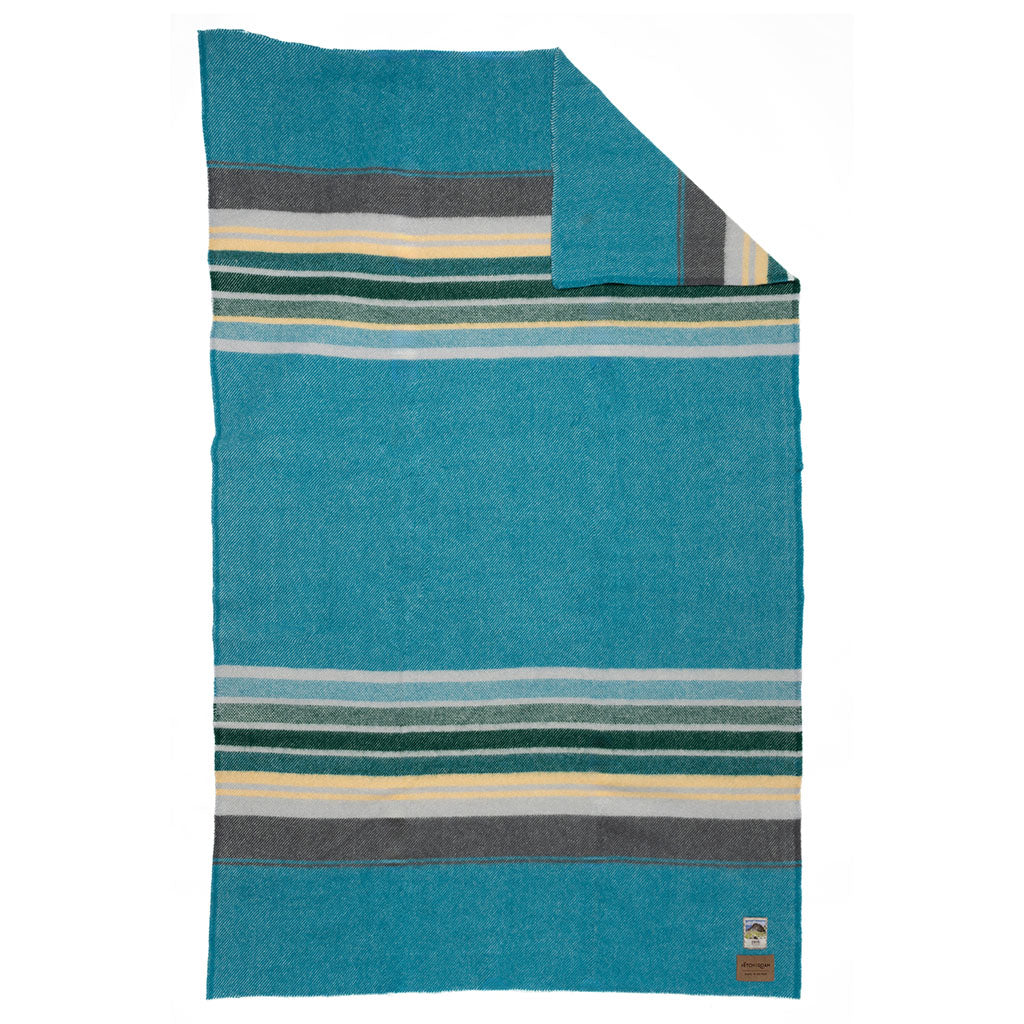
The UK’s national parks are the lungs and the beating heart of our great outdoors. Millions of walkers, campers, bikers and paddlers gravitate to these landscapes every year in pursuit of their outdoor passions. Which is exactly why they’re worth celebrating. Hitch and Roam has chosen to do so with a unique series of national park blankets, featuring signature stripes inspired by the natural colours and distinctive landscapes of our best loved parks. Each blanket is made from 100% pure virgin wool, spun by AW Hainsworth – one of the last remaining fully vertical woollen mills in Britain. Finished with a national parks patch, they make the ultimate camp blankets. But they’re also perfectly suited to daily life, offering luxurious warmth, softness and comfort in any setting.
To support their amazing work, Hitch and Roam are donating 5% of proceeds to the National Parks Foundation
With grassy moorlands, heather-clad escarpments, and Old Red Sandstone peaks, softened by weather and time, the iconic mountainous areas and limestone pavements, the landscape has unique areas. The colours represent this change in landscape and terrain exposed.
Notorious for its high, forever-rolling landscape, with volcanic eruptions of sharp, grey rock faces, the National Park can be dense with rocks and mountains one mile and then for the next 50, a vast open plain of heather-scared hills. The dense collection of the lines represents these populated high mountains and the colours that the rock and basins bring, and then fade into open nothingness as far as the eye can see.
Radiating out from its moorland core are deep river valleys cutting through enclosed farmland. With rich greens and browns being the defining colours of the landscape. Cutting through these greens are the harsh lines of granite which are found in the distinctive stonewalls, buildings and hedge banks. The lines represent these features cutting through and defining the landscape without making it feel too densely populated.
With a saturated landscape, the Snowdonia hills are a lush green, broken by the sharp greys of the mountains and quarries. The larger lines represent the mighty Snowdon and Crib Goch and then the smaller outer lines mirroring how the landscape graduates into lowland rolling hills on the edges of the National Park. The additions of blues show the sparse lakes and waters that are dotted within the valleys.
Representing the 16 lakes and mosaic of tarns, the blue takes dominance, with the detailed lines showing its many mountain streams. The colours show the wealth of the rolling landscape, from the greens of the lowland hills and woodlands to the greys and oranges of the high fells.
Coated in rolling lowland hills, towering mountains, glens and engulfed in seemingly endless lochs, the landscape is relatively simple in comparison with the upper highlands, however, the landscape, small, is still mighty. The colours and lines represent the dominance of the lochs, interspersed with the rolling lowland hills and the steep sided mountains rising from their shorelines, reflecting the change in the palette of the landscape.
With the distinctive divide of the white and dark areas of the park, the landscape graduated from the green pastures and grey limestone of the south to the deep hues of the heather and bracken and grey tones of the chiselled gritstone edges of the north. The rivers offer cut valleys a route to connect the two.
With its endless curving coastline rising from the waves and flowing into gentle rolling moorland, the contrast is dominated by the blue hues of the sea, the grey & red tones of the cliffs and the moorland that follows. The colours and lines represent this clean-cut comparison of the rolling moorland and dense coastline falling into the sea and the vast, open, nothingness beyond.
A boundless, open landscape of rolling chalk downland, rising gently and then dropping dramatically, giving contrast to the surrounding landscape. The colours represent the rolling landscape and green pastures of the hills, giving way to the greys and purple hues of the chalk band, mixed in with the clay of the northern aspect. The lines show the slow rise of the Downs from the South and then the sudden drop off in the North.
With vast, wind-swept, rolling heather-covered moorland, the Dales are notorious for its deep greens and browns, broken by swathes of grey limestone. The lines represent lowland rolling hills with the iconic 3 peaks of the Dales breaking the landscape, and the tributaries of rivers and streams feeding the moorland.