
article - || true

SAME DAY SHIPPING | FREE UK RETURNS | EU & INT'L SHIPPING

SAME DAY SHIPPING | FREE RETURNS

6 Scandinavian Cabin Getaways

These designer cabins are dream boltholes that each showcase cutting-edge Nordic design, from conceptual treehouses to solar-powered ski lodges.

Updated 2nd April 2026 | Words by Matt Jones @ WildBounds HQ


We're big fans of Scandinavian style here at WildBounds – which is why we stock a host of design-forward apparel, bags, accessories and homewares from leading Nordic brands like Skandinavisk, Klattermusen, Ojbro Vantfabrik, Amundsen, Db Journey, Glerups, Kilometer, Hestra, Primus, Crud and Sandqvist.

In fact, you could say we're slightly Scandi obsessed. Which is probably also why we wanted to show off these Scandinavian cabins, all illustrating different aspects of wonderful Nordic architectural design. The architects have created these hideouts with a unique design ethos, and each makes a fantastic contrast to a typical rustic winter cabin.

But despite their modern forms, they retain the same wonderful romance that characterises the Scandinavian cabin. Remote, wild and simple, each getaway conjures up images of roaring wood fires and traditional ways of life, from afternoon fika to evening sauna.

The cabins below range from outlandishly conceptual treehouses to sustainable ski lodges, powered by natural solar energy. They are all highly original – and some are even available to rent, which means that you can go and visit them yourself.

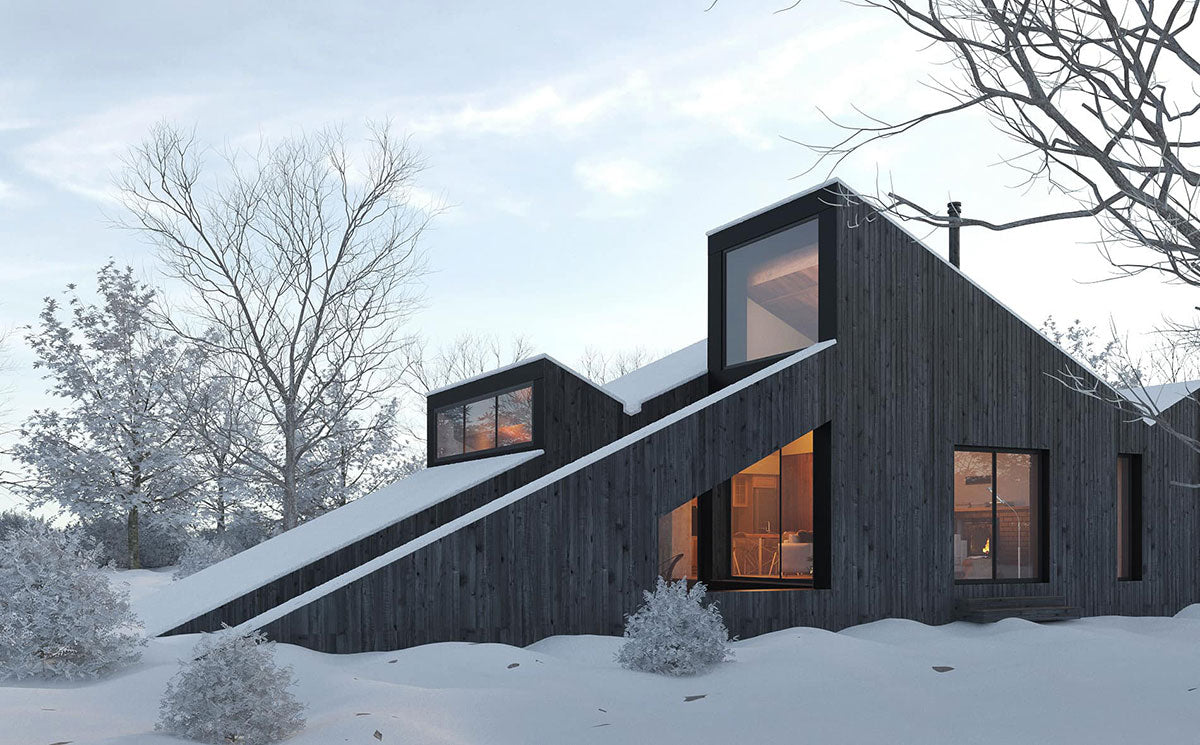
This angular ski lodge is partially sunken in the snow and hidden in a forest just outside Lillehammer, Norway.

Cabin Vindheim, Lillehammer, Norway

First up is this striking angular cabin, which is partially sunk in the snow. It is located close to the famous ski town and resort of Lillehammer in central Norway. The geometric construction creates an optical illusion that gives a magical edge to this remote outpost hidden in the forest.

The slanted roof forms maximise internal space within the cabin and prevent snow accumulating, but can also be used for sledging and skiing. The total footprint is only 55 square metres but includes all the essentials – including a small sauna plus a ski prep room within its confines. The minimalist ski cabin runs entirely on solar power and is heated with the help of a wood burner.

Designed by Oslo-based studio Vardehaugen Architects and completed in 2016, Cabin Vindheim takes its visual cue from the classic image of a snowbound cabin with only the roof exposed above the snow. By extending the gable ends all the way down to the ground, the structure becomes part of the snowy landscape rather than an intrusion upon it. The interior is clad in waxed poplar veneer, and a large four-metre window in the bedroom creates the remarkable impression of sleeping above the treetops – with the northern lights visible on clear winter nights.

Location

Cabin Vindheim sits deep in the boreal forest, in the alpine landscape close to Lillehammer in central Norway. This picturesque town – a cluster of traditional wooden houses overlooking the northern end of Lake Mjøsa and the river Lågen – is surrounded by mountains on all sides. Rondane, Jotunheimen and Langsua national parks are all within easy reach, and the region offers some of Norway's finest skiing at the resorts of Hafjell and Kvitfjell, both of which served as Olympic venues in 1994. Back in town, Maihaugen – Norway's largest open-air museum, with over 200 historic buildings – and the Norwegian Olympic Museum are both well worth a visit. Lillehammer has been recognised as a UNESCO City of Literature and hosts the Norwegian Literature Festival each May.

How to book

This cabin is privately owned, so it isn't possible to stay there. But Lillehammer and the surrounding district offer a host of alternative accommodation options, from town-centre hotels and apartments to outlying cabins and farm stays. For self-catering options across the wider region, visit visitnorway.com or try Airbnb for private rentals.

How to get there

From the UK, fly to Oslo (Gardermoen) – the Norwegian capital is well served from London Gatwick, Heathrow, Stansted, Luton and City airports by Norwegian, British Airways, SAS and Ryanair. From Oslo, Lillehammer is approximately two hours by car, bus or train; Oslo Airport has direct rail connections to Lillehammer, and the town's main transport hub, Lillehammer Skysstasjon, handles buses and taxis. Alternatively, for an epic road trip, Norway can be reached via mainland Europe and the 16-kilometre Øresund Bridge connecting Copenhagen to Malmö.

The revolving View Nest, part of the Treehouse Huts micro campsite in Norway's Brumunddal Forest.

Treehouse Huts, Brumunddal, Norway

In stark contrast to the partially sunken ski lodge, these traditional wooden treehouses in Norway's Brumunddal Forest allow visitors to sleep high up in the trees, which makes them a great place to spot the occasional bear or elk wandering past below. There are a number of treehouse hut options on this micro campsite, many of which are named after local tree species, such as the Pine Hut, the Spruce Hut, the Larch Hut and the Birch Hut.

But our favourite is the View Nest, built around a single tree. It consists of one floor and a large roof terrace – but the entire cabin revolves, so guests can manually turn the hut around to follow the sun, escape the prevailing wind or enjoy a change of view. Genius.

The seven huts are built 8–10 metres up in living trees and are equipped with everything you'd need for a comfortable stay: a wood-burning stove, a fully fitted kitchen, a toilet, shower, an airy terrace with bird feeders, and a fire pit. Several huts feature sleeping lofts with large skylights over the beds, turning the night sky into a private planetarium. Food can even be pre-ordered and delivered to the cabin before arrival – game or vegetarian, local and home-baked.

Location

The treetop cabins are located in Ringsaker's wilderness, approximately 1.5 hours north of Oslo, in a landscape defined by dense boreal forest, small lakes, and an abundance of woodland wildlife. The forest here is communal land, so guests are free to roam, pick berries, and try their hand at fishing in the nearby lakes. The huts are spread through the forest, well separated from each other for total privacy. There's also a climbing park at Helgøya – Innlandet's largest – a short distance away, with nine trails and 13 ziplines.

How to book

These are available to rent all year round. Find out more and book directly at tretopphytter.no. Nightly rates run from approximately NOK 1,999 to NOK 5,999 depending on the hut and season. Those arriving by train can email ahead to arrange a pick-up from Brumunddal station (from NOK 500 per car, up to four people).

How to get there

Fly to Oslo (Gardermoen) from any of the major London airports. From Oslo, the easiest option is to hire a car – the drive to Brumunddal takes around one to 1.5 hours. Alternatively, there are regular trains from Oslo to Brumunddal, with taxis available from the station; the hosts can usually arrange onward transport if you email in advance.

This minimalist lakeside cabin in Finland has a cross-shaped construction that offers distinctive views from each corner, designed to make the most of the sun at different times of the day, from morning to night.

Four-Cornered Villa, Virrat, Finland

How about this minimalist cabin near Lake Vaskivesi, in a remote part of Finland? It was designed by Helsinki-based Avanto Architects – Ville Hara and Anu Puustinen – to have the minimum possible impact on nature. The primary concept was to create a sustainable home, in contrast to many Finnish holiday homes, which are often heated all year round to prevent the water pipes from freezing. This building has no running water at all – but it is well insulated and heated, and all its electricity is provided by the sun.

The cross-like shape of the cabin offers four different views, including a lake and a forest. The position of each room has been cleverly chosen to suit the time of day. So, you get the morning light at the breakfast table, at midday in the dining room and in the evening in the sitting room. There is never any direct light in the bedroom, which means there is no need for curtains.

Double doors to the terrace are designed to help indoor/outdoor spaces flow seamlessly, giving the guests the option of a borderless home. The exterior is all black to contrast the interior, which is light and airy. The cabin's dark exterior also means that it effectively disappears when viewed from across the lake.

Location

The cabin sits on a horseshoe-shaped island on Lake Vaskivesi, in the municipality of Virrat in the Pirkanmaa region of western Finland – one of the most sparsely populated corners of the country, with fewer than six people per square kilometre. The lake is famous locally for its pike-perch fishing, and vegetables and herbs are grown in the villa's own kitchen garden. The wider Virrat area – nicknamed the "town of a hundred lakes" – offers rewarding hiking and cycling, including the Näsijärvi Lake Trail, as well as the remarkable Helvetinkolu gorge, part of a national park known for its dramatic faulted bedrock scenery. Virrat is also Finland's official Midsummer town, making it a special place to visit in June.

How to book

This cabin is privately owned and not available to rent. The Virrat and Pirkanmaa regions do, however, offer a range of lakeside cottage rentals well suited to those inspired by this style of retreat. Search visitfinland.com for curated options, or browse Airbnb and specialist site Lomarengas.fi for Finnish cabin rentals.

How to get there

Fly to Helsinki (Helsinki-Vantaa Airport) from London Heathrow, Gatwick or Stansted – the flight takes approximately three hours. From Helsinki, the nearest major city to Virrat is Tampere, roughly two hours by train or bus from the capital. Virrat itself is approximately a further 1.5 hours' drive north of Tampere, so hiring a car is strongly recommended for exploring this remote and rewarding region.

The Treehotels in Swedish Lapland are a series of unique, design-led spaces perched in the trees, offering a unique vantage point to enjoy the Northern Lights.

Treehotels of Lapland, Sweden

For a more luxurious, design-conscious treehouse experience, there are the eco Treehotels in Swedish Lapland, where visitors can stay in a range of unique and distinctive spaces that include The Nest, Mirrorcube, The UFO, Bird's Nest, Blue Cone and 7th Room. Each cabin is perched high up in the boreal forest canopy, just 60 kilometres south of the Arctic Circle. At the right time of year, this makes them a superb place to catch the famous Aurora Borealis, or northern lights.

Each of the Treehotels has been designed by a different architect. The Mirrorcube is particularly spectacular – surrounded by mirrored walls that both reflect and blend in with the surrounding forest, it disappears and reappears as the sun moves from behind the clouds.

The Bird's Nest is a camouflaged sanctuary that works in perfect harmony with the surrounding forest.

Then there's the Bird's Nest, whose exterior is camouflaged with branches foraged from the forest, creating a hidden cocoon. Small porthole windows allow in natural light, and the space is accessed via a remote-controlled retractable ladder that can be fully withdrawn once guests are inside, leaving only the branches of the nest's base visible from below. The most recent addition, the Biosphere, features a facade of 340 wooden bird nests, offering a remarkable 360-degree connection with the local wildlife.

Meals are served at the wonderfully cosy Brittas Restaurant in the main guesthouse, where the menu celebrates local and seasonal produce – think Arctic char, moose, reindeer and the prized Kalix caviar, often called "red gold".

Location

The Treehotel is located in the small village of Harads, in the heart of Swedish Lapland, nestled in a tall pine forest beside the Lule River valley. The surrounding landscape is one of vast boreal wilderness – ancient spruce and birch forests, frozen lakes, and reindeer roaming freely through the trees. In winter, the long dark nights create ideal conditions for northern lights spotting, dog sledding, snowmobile safaris, and sleigh rides. In summer, the midnight sun illuminates the forest, opening up hiking, kayaking, fishing, and horse riding. A short drive away, the thundering whitewater rapids at Storforsen are worth the detour.

How to book

All eight treehouses are available to rent directly through the Treehotel. Find out more and check availability at treehotel.se. UK-based tour operators including Scott Dunn and Best Served Scandinavia also offer packages that include flights and transfers.

How to get there

From the UK, fly to Stockholm Arlanda, then connect to Luleå Airport – the total journey time is around four hours. The Treehotel is approximately a 70-minute drive from Luleå Airport; the hotel can arrange transfers, or hire a car for flexibility. There is also an overnight train from Stockholm to Boden (approximately 12 hours), from where the hotel is a 35-minute drive – a spectacular way to arrive, with views of the Lapland wilderness rolling past the window as you travel north.

The Woodnest treehouses cling to the pine-forested hillside above the Sørfjord in Odda, western Norway, designed by architects Helen & Hard.

Woodnest, Odda, Norway

Our fifth cabin is perhaps the most arresting of all: four extraordinary treehouses perched on a steep forested hillside above the Sørfjord, one of Norway's most magnificent fjords, in the small town of Odda in western Norway. Woodnest was designed by Norwegian architects Helen & Hard and is a remarkable feat of low-impact design – each pod is fastened to a single pine tree using an innovative steel collar system that allows the tree to continue growing undisturbed, leaving no ground footprint whatsoever.

The cabins are clad in natural timber shingles that echo the pattern of a pine cone, allowing them to blend seamlessly into the forest canopy. Despite their modest 15-square-metre footprint, the two original treehouses sleep up to four people, while the two newer "Mountaintop" cabins – positioned even higher up the hillside – feature a ceiling-mounted double bed that lowers on demand, a bathtub, and views that stretch for miles across the fjord and the surrounding mountains. Each pod is equipped with underfloor heating, a small kitchenette, and a shower room. Arriving at Woodnest requires a short but steep uphill hike through the forest – a gentle transition from everyday life that sets the tone perfectly.

Location

Odda sits at the southern tip of the Hardangerfjord – Norway's second-longest fjord – surrounded by some of the country's most dramatic mountain scenery. The surrounding Hardanger region is a paradise for hikers and outdoor enthusiasts, with trails leading to Trolltunga (the famous flat rock ledge jutting out above the fjord), the Buerbreen glacier, and the twin falls of Låtefossen. The nearby Folgefonna National Park contains one of Norway's largest glaciers, while the valley is renowned for its fruit blossom in spring and its local apple cider. The historic pilgrimage route Dronningstien ("Queen's Path") runs directly above the treehouse site, offering extraordinary views of the fjord below.

How to book

All four Woodnest treehouses are available to rent directly through the Woodnest website. Advance booking is strongly recommended – these cabins are popular and availability fills up quickly. Find out more and book at woodnest.no. Note that weekends require a minimum two-night stay, and there is no check-in or check-out on Saturdays.

How to get there

From the UK, fly to Bergen Airport (Flesland) – Bergen is well served from London by several carriers, with the flight taking approximately two hours. From Bergen, Odda is approximately a three-hour drive; the most scenic route takes you via Jondal and involves a short drive-on ferry crossing over the Hardangerfjord (no advance booking required). Bergen is also connected to the wider region by rail, and onward buses run towards Odda, though hiring a car is recommended for the flexibility to explore the stunning surrounding landscape.

A hand-built wilderness treehouse hidden in the boreal forest of Enontekiö, Finnish Lapland, with no light pollution and no WiFi – just the Arctic silence and the northern lights overhead.

Wilderness Treehouse, Kätkäsuvanto, Finnish Lapland

If the cabins above feel too designed, too polished or too easy to reach, this final entry is for you. Hidden in the Saivomuotka wilderness of Enontekiö – the outermost northwest corner of Finnish Lapland – this hand-built treehouse is the most remote and personal retreat on our list. It was constructed by its owners, Tiia and Markus, entirely from locally sourced materials and with a genuine spirit of eco-consciousness. Every detail, they say, has been crafted with care. This is not a hotel concept or an architectural commission. It is a labour of love – a private hideaway that the couple have opened up for a maximum of two guests at a time, welcoming visitors as family rather than customers.

The treehouse sits 300 metres into the forest from the nearest track, completely surrounded by trees and wildlife. There is no WiFi and no light pollution – your only neighbours are the birds and animals of the boreal wilderness. Despite its off-grid spirit, the cabin is well equipped: a wood-burning stove and central heating, a kitchen with gas hob and fridge, a bathroom with shower and toilet, a sauna, a BBQ, and a terrace and balcony from which to take in the silence. The hosts' ethos is reflected throughout – waste separation is required, a noise curfew between 11pm and 7am is observed out of respect for nature, and the platform is listed through Nature.house, which donates five percent of turnover to local nature conservation projects.

Location

Kätkäsuvanto is a tiny settlement in the municipality of Enontekiö – a vast, sparsely populated expanse of fell, forest and river in the far northwest of Finland, where the country meets Sweden and Norway at a single border point. This is genuine Arctic wilderness: Enontekiö is the best place to observe the northern lights in Finland, with the highest rate of occurrence of any municipality in the country – around Kilpisjärvi, the Aurora Borealis can be observed on an average of three out of four nights during the dark season. The region contains all of Finland's 21 mountains above 1,000 metres, including Halti – the country's highest peak at 1,324 metres. The Pallas-Yllästunturi National Park, Finland's third largest, lies to the south, offering outstanding winter ski trekking and summer hiking. Reindeer herding, husky sledding, snowmobile safaris, ice fishing and river kayaking are all available locally, and the Fell Lapland Nature Centre in nearby Hetta is an excellent introduction to indigenous Sámi culture and the natural history of the region.

How to book

Book directly through Nature.house at nature.house/cottage/77691. The treehouse sleeps two and pets are welcome. Free cancellation within 24 hours of booking. As a small, owner-run property in a very remote location, availability is limited – book well in advance.

How to get there

During the high season (late winter), travellers can fly directly to Enontekiö Airport from Helsinki. Finnish carrier Finnair and others serve Helsinki-Vantaa from London Heathrow, Gatwick and Stansted, with the flight taking around three hours. The Kittilä international airport in Lapland is also around two hours away, as are Kiruna in Sweden and Tromsø in Norway. From Kittilä, a hire car is the most practical onward option; the drive north to Enontekiö takes approximately two hours along the E8. For those preferring rail, Kolari is the northernmost train station in Lapland, from which a bus runs north to Hetta in around two hours. A hire car is strongly recommended for the flexibility to explore this vast, road-sparse region.

And if that selection of epic hideaways has given you an urge to pack a bag and go travelling, then have a look at our collections of awesome bags and travel accessories.