
Camp
  • Climbing Toubkal in Winter: North Africa’s Highest Peak
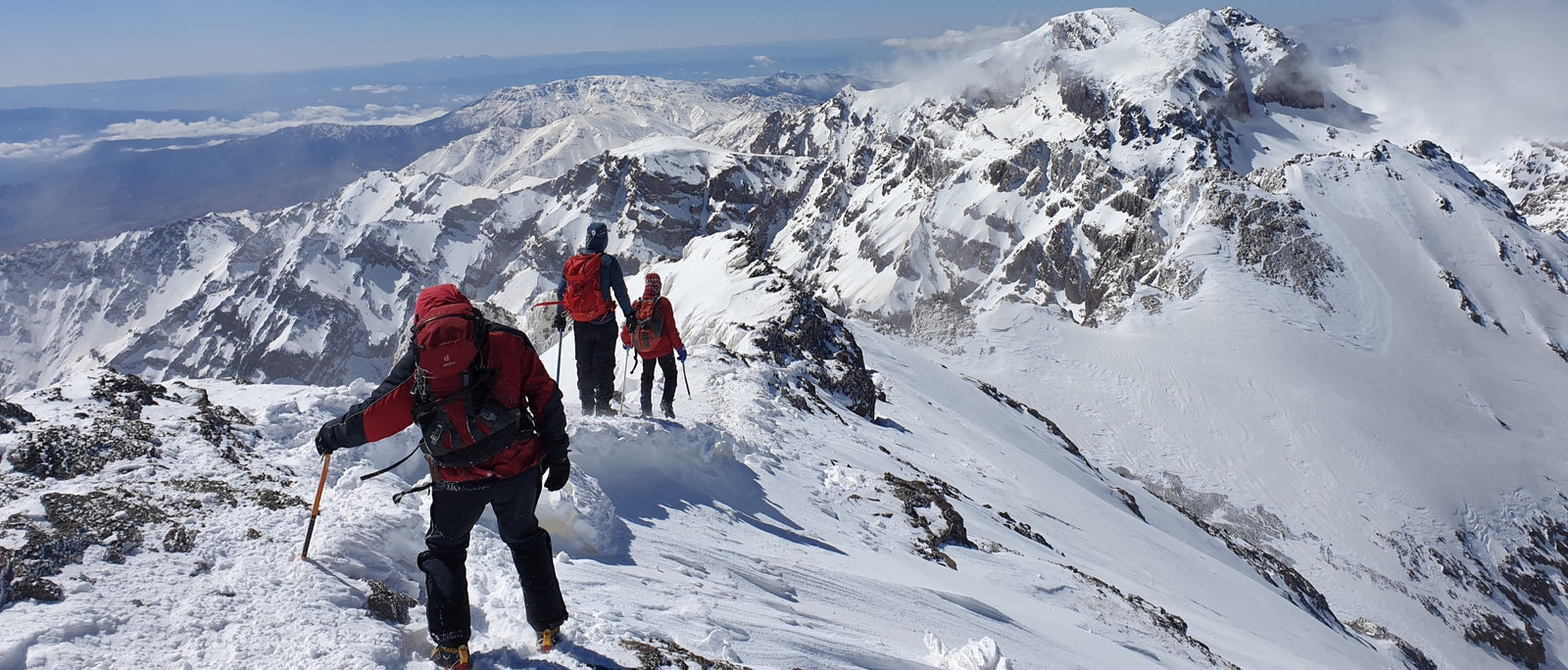
    Mount Toubkal, the highest peak in North Africa, is booming as an adventure destination. Here’s what a winter ascent via Ikhibi Sud is really like – and what the boom means for the High Atlas.

    Mount Toubkal, the highest peak in North Africa, is booming as an adventure destination. Here’s what a winter ascent via Ikhibi Sud is really like – and what the boom means for the High Atlas.

    19th October 2026 | Words and photos by Emily Woodhouse


    It’s 4am and somewhere in the dark, inches above my face, is the start of the sloped bunkhouse ceiling, covered in black mould. A symptom, no doubt, of a winter of hikers and wet kit in an unheated stone room filled with alpine bunks. It’s not uncomfortable, but it’s certainly not the Alps. In the words of French geologist and mountaineer, Louis Neltner, in his report to the French Alpine Club back in the early 1900s, the mountains of the Toubkal range are neither more nor less beautiful than the Alps; they are other.not

    The refuge is fairly full – multiple dorm rooms full of bunks are occupied, the social areas and dining room full last night. Everyone else was up at 3am to try to reach the 4,167m summit in time for sunrise. We, a group of friends from a UK Mountain Rescue team, have no such aspirations. We’re here for the week and would rather have the extra hour of sleep. Surrounded by a commotion of kit faff, packing and leaving in the corridor, we breakfast off the common room’s polished metal tables all but alone, lit by headtorch and candlelight. The power won’t come back on until the sun’s up at least.

    Then it’s packs on, boots on and crampons clipped in the vestibule. Outside, dawn is breaking over the snow at the far end of the valley, turning the sky above Imlil pink and blue. But clear skies are what we want. We came up to base camp from Imlil through a blizzard. It had been touch-and-go whether we’d be allowed past the police checkpoint in the village, because of the weather on the mountain.

    Toubkal’s booming popularity

    Morocco in general and Toubkal in particular is a fast-growing destination for adventure tourism. The accolade of being the highest point in North Africa (the highest in Africa overall being Kilimanjaro) and the proximity to western Europe, makes it an easy sell. You get to experience a very different culture with only a short flight. It is a straightforward ascent – the Normal route is alpine grade F (facile) - and it is truly a trekking peak in the summer. But there is very little infrastructure and no real rescue cover for the area. You certainly won’t be picked up by helicopter. Since 2018 it’s been compulsory for all groups to hire a local guide.

    Some of my team members did this same trip 10 years ago and, for those back again, the difference was stark. Not the mountain itself, but in terms of how many people were climbing in the area, how many more cafes and shops there were on the ascent from Imlil (3 or 4 permanent shacks vs a single stall a decade ago) – even the size of Imlil itself. It is, perhaps, a difficult and delicate balance. Obviously, any increase in tourism should encourage development, which should in turn – you hope – boost the local economy and give back directly to the local people. On the other hand, an economy that revolves entirely around tourism is not generally a good thing and has a very different feel. I’m not saying one thing or the other has happened yet, but it was interesting to think about as I walked. It feels like Toubkal National Park is at a junction point that could go one of two ways.

    Winter skills and an early start

    We were here for a week of winter mountain experience, rather than just to bag the highest peak. Of course we wanted to climb Toubkal, but we had our sights on other mountains in the area too, weather permitting. After a day of acclimatisation and winter skills on the slopes around base camp, the forecast looked good for an ascent of Toubkal the next day. So, we duly set our alarms.

    Four climbers in winter jackets, rucksacks and crampons walk in single file up a snowy slope towards dark, rocky crags, carrying ice axes and trekking poles under a pale blue sky.

    Crampons on, heading up the eastern foot of Toubkal.


    On the smooth, convex snow slope above the refuge, the eastern foot of Toubkal rose up ahead of us. We started zigzagging across, climbing slowly but surely with steady, measured steps. Not least because we were still half asleep – or I was. A small whisper of wind accompanied the crunch of crampon points and the tap of ice axes. We gradually gained height until the slope broke into a long cwm, with crags either side. Here was our first chance for a rest.

    As we sheltered behind a jagged brown boulder twice our height, a long train of hikers were coming downhill through the cwm, returning from the summit. Their brightly coloured jackets stood out against the snow, clustered in groups of two and three. As the first ones reached us, we asked: “Did you get your sunrise?”

    “Covered in cloud.” And I could believe it. You can’t normally see the summit from here, thanks to the shape of the mountain, but the cwm was capped with a straight line of fog, obscuring anything higher.

    Two climbers in hoods and hats rest beside a rock in the foreground, looking across a broad, smooth snow-filled cwm where tiny groups of walkers descend; thick fog caps the head of the valley.

    A snack stop in the cwm as other teams make their way down.


    An unexpected rescue

    Munching on cereal bars as we watched the early-risers’ passage, one group caught the eye: it looked like someone was being supported, or possibly carried, between two other people. As they got closer, we could see the middle person had one arm across each of the others’ shoulders and they were holding her up. Maybe an ankle injury? But upon reaching us and the wind shelter, she passed out.

    Several people in hoods, buffs and winter jackets crouch and stand around an orange group storm shelter on the snow, with trekking poles planted beside them and a rucksack in the foreground.

    Treatment under way in a storm shelter, within minutes.


    If you’re going to fall unconscious on a mountain, doing it at the feet of a rescue team on holiday is one of the best places to do it. Nobody even had to say anything. She was under a storm shelter, obs taken and a doctor giving her treatment within minutes. It was simply the altitude, which can happen to anyone, especially if you don’t take time to acclimatise – as many ‘do it in a weekend’ trips push you not to. Of course, the very best treatment for altitude is going down. Once conscious and stable, our casualty continued their descent and we made our way up the snow slope to the col.

    A steep snow slope in the foreground looks across to a snow-filled cwm backed by dark, craggy rock walls and a notch at its head, with heavy grey cloud above and a faint pinkish tint on the snow.

    The view from the foot of Ikhibi Sud.


    Ikhibi Sud to the summit

    The route we were taking is called Ikhibi Sud – as in the South Cwm, in a combination of the local tongue and colonial French. The south col, Tizi n’Toubkal, looks out across Lac Ifni in a long, sheer drop, with a small cornice. On good days, you can see as far as the Anti-Atlas range and the northern edge of the Sahara Desert. We, however, had reached the bottom of the cloud base and could only see the summit in brief glimpses and flashes as the cloud moved through with the wind.

    Two climbers in crampons, their jackets and rucksacks dusted white with frost, scramble up a snowy ridge of rime-covered rock into dense cloud, with others following close behind.

    Climbing into the cloud, everything coated in rime.


    The higher we climbed the colder it got. Even without the wind chill, our outer layers were coated in a powdery layer of white, like we’d been left out in a hard frost or spent too long in a walk-in freezer. The crags above us were wrapped in a thick layer of rime ice. No one wanted to stand still for too long, but we were starting to feel the effects of the altitude as we plodded slowly but surely upwards.

    Three climbers in red and dark jackets walk across a wind-sculpted snow plateau under a deep blue sky, heading towards a bank of cloud with snowy peaks emerging beyond.

    The cloud begins to lift on the summit plateau.


    We took the final edge on the windward side, along a narrow ledge of boot-compacted snow, with significant run off, disappearing into white in all directions. Then, magically, just as we rounded the corner of the summit plateau, the cloud split to reveal the iconic black pyramid that marks the summit of Toubkal.

    Standing on the roof of North Africa, a tapestry of black, white and blue stretched out below us: snow, crag and ice. Our guide encouraged us to climb onto the pyramid structure itself – a delicate feat in crampons – to be sure we could each claim to be the highest individual in the entire northern continent. The cloud whipped in and out around us, so we didn’t stay for long – enough to appreciate the view and enjoy a fruit pastille or two, nearly frozen solid.

    The frost-rimed black metal summit pyramid, covered in painted names and stickers, stands against a deep blue sky; a climber in a red jacket rests against a boulder beside it, with snowy ridges stretching into the distance.

    The summit pyramid – the highest point in North Africa.


    It’s possible to descend via Ikhibi Nord, but a large cornice had formed on it, and our guide decided the risk was too high. Instead, we descended back the way we’d come and were treated to fabulous views now the cloud had opened up. The crest of the ridge was particularly good, with the sub-summit of Toubkal West rising opposite Ikhibi Sud. And then down into the cwm with a clearing view of the imposing black crags of Biguinnoussene (4,007m) directly opposite. We loped down through the snow with the satisfying crunch and sink of crampons. There was far less wind down here and, now in full sun, it was actually becoming quite hot: a reminder that we were in fact in North Africa!

    A line of five climbers crosses a snow-covered slope scattered with dark scree, heading towards a steep, rocky peak half wrapped in swirling cloud, with patches of blue sky above.

    Toubkal West appears through the cloud.


    Beyond the summit: winter mountaineering in the High Atlas

    The surrounding mountains are almost unclimbed compared to Toubkal. Yet, if you have any inclination towards alpinism, there are plenty of worthy routes and objectives in the area. You could easily fill a week and more. It is different from any experience in the Alps. Not just because of the lack of luxury huts and ski resorts. These mountains haven’t been built on yet. But it feels different too, the culture, the language and the mountaineering history – though the latter lurks deep in the alpine journals if you look hard enough. Still, it leaves many possibilities and, as the brochures say, all only a short haul flight from Europe. For us, all that was left to do was to head back to the refuge for mint tea and to plan the rest of the week.

    Three climbers descend a wide, smooth snow-filled cwm between dark rocky slopes, with two more walkers far below and a bank of cloud lifting from the valley ahead to reveal blue sky and a distant snowy summit.

    Dropping down Ikhibi Sud as the cloud clears.


    Practical tips

    • Do your research before you go. Tourism in Toubkal National Park is growing apace, and although I believe there is a world where Toubkal may end up like Kilimanjaro, currently safety and infrastructure are still chasing to catch up.
    • Book a reputable guide and remember that they will not behave like a European Alpine guide: most solely guide the way, that’s it.
    • Find or create an itinerary that gives you time to acclimatise properly to the altitude. Although Marrakesh to summit in a day is possible, it’s certainly not recommended. Spend a night in Imlil, and certainly at base camp, if you can.
    • Although many people do, I would not recommend Toubkal as a first place to try on crampons. Consider booking a winter skills course somewhere like Glenmore Lodge or Plas y Brenin before you go.

    Emily Woodhouse is a writer and Mountain Leader. She had lived on three continents before she was 3 years old and has been climbing mountains since she first stepped into Yosemite Valley as a toddler. She has been an active member of Mountain Rescue (UK) since 2015 and is very involved in outdoor education. Her work has been published in numerous magazines and newspapers, with a focus on adventure travel. She is also the author of the Cicerone guidebook ‘Climbing Toubkal’.

    Website Instagram

    Also in Adventure

    7 Under the Radar Hikes and Treks
    7 Under the Radar Hikes and Treks

    No phone signal, no crowds, and sometimes no guidebook either. Just seven lesser-trodden trails for your bucket-list – from lunar salt lakes in Tajikistan to glacier-carved peaks in Uganda.

    5 Seen Wanderung - Switzerland's Five Lake Hike | WildBounds
    Switzerland’s Five Lake Hike: A Guide to the Pizol 5-Seen-Wanderung

    Everything you need to know about Switzerland’s Five Lake Hike – the Pizol 5-Seen-Wanderung. Routes, difficulty, getting there and what to expect.

    Britain's Best Lighthouse Walks | Adventure | WildBounds UK
    Britain’s Best Lighthouse Walks

    From Cape Wrath to Beachy Head, discover Britain’s best lighthouse walks, with distances, difficulty grades, getting there guides and coastal highlights.