
Into the Wind: Solo Bikepacking Down Scotland’s Great North Trail
From Thurso to Struy the wrong way round – straight into a headwind – Paul Glendell rides the Great North Trail through the wild Flow Country, featuring remote glens and a cast of unforgettable characters.
16th July 2026 | Words, pictures and video by Paul Glendell
“Sorry – David Attenborough commissioned you?” I asked, checking I’d heard the chap correctly. “Yes, to make a film in Ghana,” he replied nonchalantly. I met Howard and Daphne on the train to Thurso, in the very north of the Scottish mainland, at the start of my bikepacking trip.
We continued talking as the train headed north. “When I was a lad of fifteen, me and some friends took the train from Aberdeen to Ballater and camped on top of Ben Macdui,” Howard continued, recounting another of his adventures. That trainline closed in 1962, I was thinking. “We walked on the next day into Aviemore and were told the war was over.” My brain went into overdrive as I tried to calculate Howard’s age: if the Second World War ended in 1945 when he was fifteen, he must be ninety-six by now.
Howard and Daphne on the train to Thurso. Not bad for 96 years old!
“What are your plans?” I asked. “Daphne and I are staying in Thurso overnight then catching the ferry to Orkney tomorrow,” he replied. As the train pulled into our final stop, I handed Daphne her rather heavy rucksack; she was probably only a few years younger than Howard.
“Are you okay to walk to the hotel?” Howard asked Daphne. “It’s about 300 yards.” She confirmed that was fine. As I struggled to manoeuvre my bike onto the station platform, the train guard handed Howard his walking frame, wishing him and Daphne a safe onward journey. It was further proof that travelling solo can lead to some interesting conversations – with some remarkable people.
Thurso was unseasonably cold for May, even by Scottish standards. The difference in degrees from Aberdeen, where I live, was very noticeable. After checking in at my hotel and getting some food, I walked down to the beach and watched the surfers trying to ‘catch’ the crashing breakers in the bay. It was 10pm and it was still light.
Fortunately, I had brought my winter cycling gear with me, and I needed the extra layers as I left Thurso. I was heading south on The Great North Trail, doing it the wrong way. The mostly off-road trail stretches from Middleton in the English Peak District to either John o’ Groats or Cape Wrath on the north coast of Scotland, depending on your choice of route. It only occurred to me some time after planning my ride that I would be heading into the prevailing wind. Ah well – too late now.
The uphill ride as I set off that morning was a surprise but did at least help me to warm up. The large, flat, open expanse of landscape that I had expected soon came into view. Field borders were defined by huge slates stood on end like lines of gravestones. The frequent calls of curlew, lapwing and skylarks raised my spirits, as did the occasional patch of blue sky between the grey clouds. I came across the ‘Cookie Barrel’ by the side of the road – an honesty shop with some tempting goodies. Sadly, I had no cash.
The Cookie Barrel, just out of Thurso.
In this area of Scotland, even the farmed landscape felt remote, with only scattered farmhouses and the very occasional tiny hamlet. There were no shops, let alone cafes.
The road to Forsinard from Thurso.
Diverting from my route, I decided to take a look at remote Altnabreac Station, necessitating a ride down a nine-kilometre gravel track – the only way to get there other than via train. It’s a ‘request stop’, so you literally have to wave at the train to get it to stop for you. Little more than a platform, it was furnished with a weather shelter and, pleasingly, cycle racks. Standing on the deserted platform, hemmed in by forest, there was hardly a house in sight, no matter which direction I turned.
Altnabreac request stop station.
The Flow Country
The Flow Country, internationally protected for its vast peat bogs, is an important area not just for its unique mix of plant and wildlife but also as a store for huge amounts of carbon dioxide. Sadly, forty years ago some areas were planted with conifers in the mistaken belief that tree planting would capture even more carbon dioxide, when in fact planting trees in a bog has the opposite effect. This landscape is unique in the UK and undeniably bleak in bad weather. Trees don’t naturally grow here, leaving travellers without protection from either blazing sun or pouring rain, but for me the weather was kind and the gravel track made for easy riding. It’s one of the last great wildernesses in the UK, having never been farmed or grazed by domesticated livestock.
The river Thurso, winding through the Flow Country.
The wilderness of the Flow Country’s peat bogs.
Headwinds to Kinbrace
Leaving the tiny hamlet of Forsinard the next day, I passed the Flow Country Visitor Centre, and yet another ‘request stop’ train station. With a very strong headwind, the twelve kilometres to Kinbrace took me almost an hour. Finally turning west, with the wind now behind me, my pace picked up. I stopped to watch a male hen harrier hunting in the valley below. These beautiful raptors are now rare in the UK, but this is one of their strongholds. A little further on, a herd of at least fifty deer grazed the semi-farmed landscape.
There was a choice of route for this section: either off-road, culminating in a peat bog with no visible path for several kilometres, or a longer 90-kilometre section, with a serious hill at the end of the day. Perusing the pages of the Great North Trail guidebook, I noted that “the shorter route is unmarked and you will need to carry your bike at points”. Neither of those prospects appealed. I decided to go for the latter, longer route.
Loch Achnamoine, on the road to Lairg.
It was 70 kilometres to the next inn, though I’d been warned that opening times could be variable. I arrived after a hard ride, desperately in need of a break. I pushed the door open and walked inside, hopeful of a coffee and some food. A lovely, comfortable-looking place, I thought. The bar was ominously empty and, despite several calls of ‘Hello?’, I got no answer. However, hearing a shuffling noise from the rooms above, I ventured upstairs.
“Are you open?” I asked.
“No,” came the grumpy reply. I hesitated, wondering if that was the end of the conversation. “The front door is down there,” he added, clearly indicating that it was, and that I should leave. Yes, I know, I thought – I’ve just walked through it. Maybe you should keep it locked when you’re closed? Fortunately, I had a couple of sandwiches with me, so I sat in the garden and ate them in the ever-increasing wind.
A Warmer Welcome
The 10km ride to the next rest stop, the Crask Inn, was both uphill and into that wind. It was really hard going on a loaded bike at the end of the day. Several times I thought I might have to walk the steep sections. But I made it. Luckily, the Crask Inn was the complete opposite of the previous establishment – not only open but a lovely, friendly place. The coffee and snack were really appreciated, but even more so the company of fellow cyclists. All had, of course, come the other way, with the wind behind them, and seemed unimpressed with my southbound struggle to get there.
A friendly reception awaits at the Crask Inn.
Into Alladale’s Wild Glen
A sharp turn west at Bonner Bridge after a good night’s rest in Lairg found me once again heading into the wind. Strathcarron is a wonderful glen. The singletrack road undulated for 15km before my route took me off the tarmac and into the Alladale wilderness reserve. I met a man named Michael, who turned out to be the head warden, standing beside his pick-up, waiting for colleagues who were repairing the gravel road. Once I told him of my plans to ride through Glen Mor, he was keen to tell me about not only what I might see en route but of the whole project to rewild the estate.
The river Carron, on the road to Aultguish.
“We have planted over a million trees,” he told me, “Helped with the Scottish wildcat breeding programme to release captive-bred cats, and worked with the Zoological Society of Scotland to boost numbers of red squirrels on the estate. We would like to reintroduce lynx as well, and eventually even wolves.” Michael was particularly keen to tell me about Alladale’s work with local school children, educating them about wildlife and conservation issues as well as running outdoor experiences for them offering mountain biking, camping and hiking on the estate.
“There are a pair of eagles nesting in Glen Mor,” he told me, “So keep your eyes out for one.”
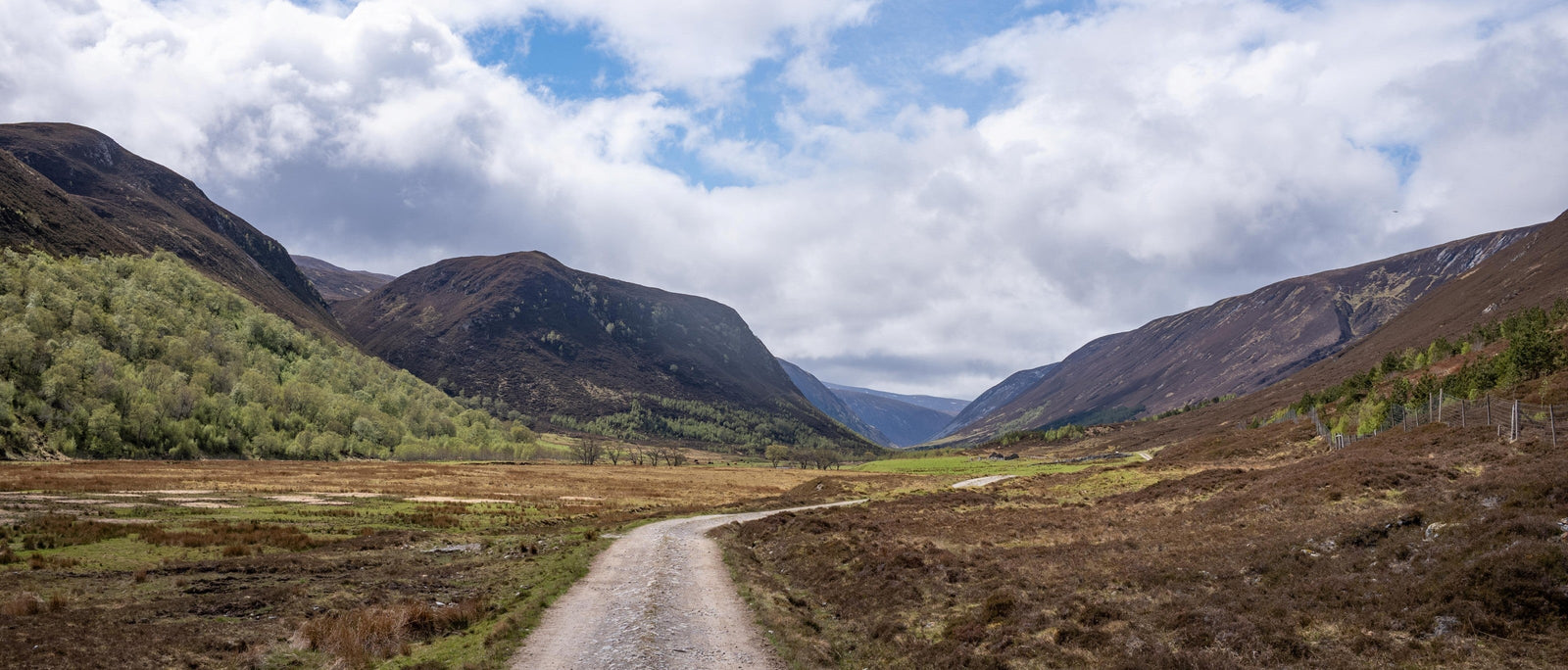
It was 10km to the top of the glen, which marked the edge of the Alladale estate, then another 10km to the main road. Glen Mor is a wonderful ride through deciduous forest, with natural regrowth supplemented by native tree planting, the sun backlighting the woodland as I rode along the track.
Glen Mor, on the road through the Alladale wilderness reserve.
Leaving the glen behind me, I carried on down a rough track towards the main road. Ahead I thought I could see a crow hassling a red kite – it’s hard to work out the scale of birds in the distance. As I got closer, I realised what I thought was a crow was in fact the red kite, and it was tangling with a white-tailed eagle. The pair, locked in their aerial combat, circled down the valley alongside me for several minutes.
Looking back at Glen Mor and the trail I had cycled.
It had been a wonderful day away from the hassle of traffic, but the tranquillity was shattered the moment I joined the A835. Speeding vehicles and articulated lorries passing at 60 miles per hour really wasn’t a great end to the day.
Leaving the Altguish Inn the next morning, I headed south again. There was a fresh covering of snow on the mountain tops. I was so pleased to get onto the quiet of the forest roads again.
I met a fellow bikepacker in the village of Contin. We sat at a picnic table and exchanged tales of the route. Like all the others I’d met, he was also going north. I handed over my phone to show him my day’s route. He looked shocked. He must have been in his early thirties – half my age. “You’ve done more miles than me today! Oh wait – you’re working in kilometres,” he laughed, as he handed the phone back.
I asked him about the next stretch. “There is a lot of uphill once you leave the road, but the track surface is okay. It’s a bit boggy in places, though.”
A short while later I came to a junction. My route went to the right. The weather looked grim in that direction, with dark clouds above. The forecast wasn’t at all good. I had been really lucky so far, with virtually no heavy rain, and heading into the remote mountains again somehow lost its appeal. I turned left and into Beauly instead, where I found my first lunchtime café of the trip to wait out the expected downpour – which, of course, didn’t happen.
The Black Water river, on the road to Beauly.
Somehow, I had lost my desire for more wilderness adventure, so I recalculated my route along what turned out to be a very tranquil valley on a minor road along the river Beauly. The cluster of houses that make up Struy marked the end of my travels along the Great North Trail – for now.
The river Beauly, near Struy.
I’ll be back to finish what I started. There’s still over 900 kilometres between Struy and Middleton – Glencoe’s peaks, the shores of Loch Lomond, the softer moors of the Peak District – waiting for me. And call me contrary, but next time, I think I’ll still be doing it the wrong way round: even if it means fighting the wind the whole way.
Paul Glendell has been a professional photographer for more than thirty years. His pictures have appeared in several of the world’s leading publications, including Timeand Lifemagazines. He undertakes commissions for nature charities and BBC News online, as well as work for photo agencies, consumer magazines and corporate clients. His images have been widely exhibited across Europe, with solo exhibitions in the UK, Slovakia, Hungary and Romania. Visit Paul’s website at glendell.co.uk.