Camp
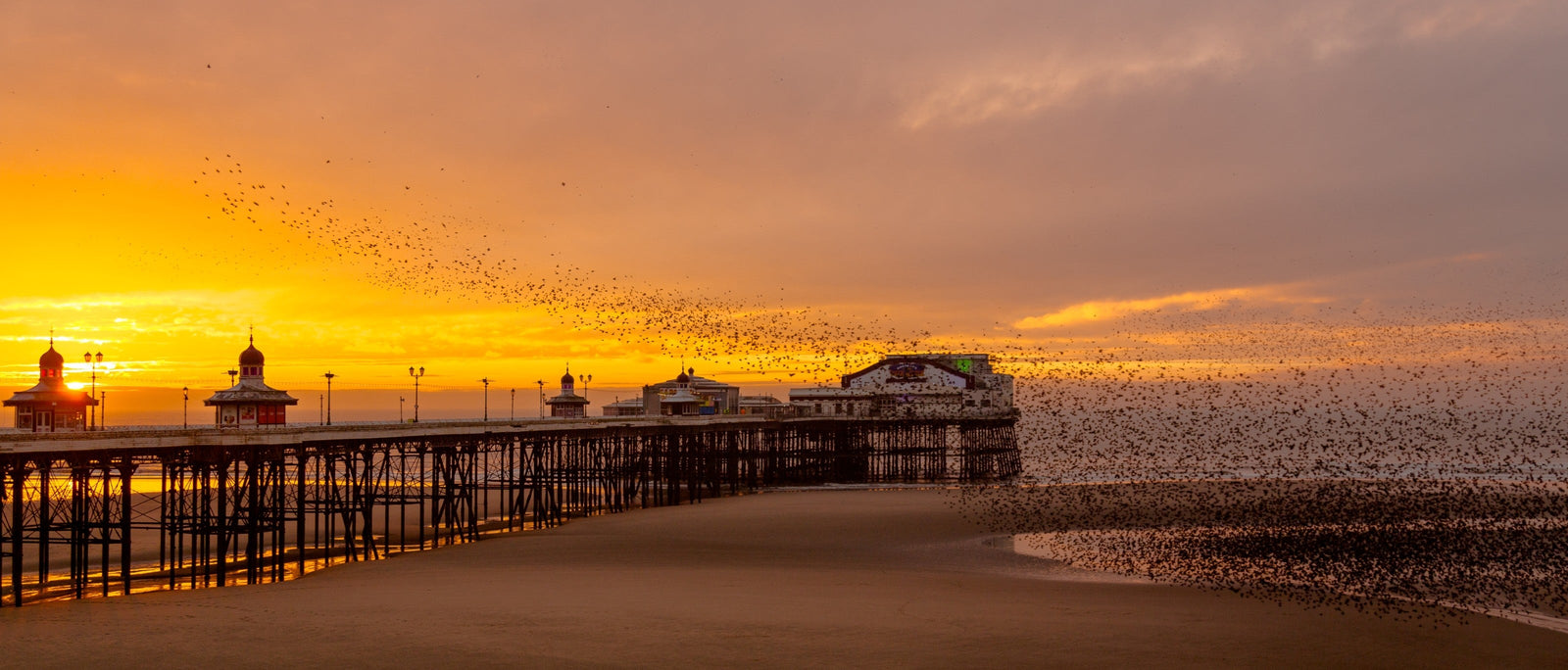
  • Where to See a Starling Murmuration

    In 2017, a freak mountain accident forced Austrian climber Angelino Zeller to take a new path. Six years on, he’s pushing the boundaries of paraclimbing further than ever before.

    Where to See a Starling Murmuration

    24th November 2026 | Words by Dave Hamilton | Images via Adobe Stock


    There are few natural phenomena as impressive as a starling murmuration. Every year, these diminutive but remarkable birds group together in large numbers, sometimes in their tens of thousands, to evade predators before their nightly roost. The result is spellbinding, with each bird flying in unison, forming huge, ever-shifting clouds which change form in the blink of an eye.

    Although to us the formations are mesmerising, for the starlings, the experience might be closer to a state of constant panic. The birds on the outside of the group can be picked off by aerial predators – particularly peregrines and sparrowhawks – at any point. Every single individual wants to be safe in the cosy centre and not vulnerable to attack on the periphery. The pulsating mass of birds is, at heart, a high-anxiety panic dance. In human terms, it is like thousands of commuters in a busy Tube station trying to avoid the taunts of an aggressive drunk.

    Male common starling perched on a weathered wooden fence post, its dark feathers glossed with purple, green and blue, with a yellow bill

    Up close, a starling’s iridescent oil-slick plumage is anything but drab. Together, thousands become something else entirely.


    Why do they happen?

    In the 1930s, ornithologist Edmund Selous came up with the notion that the birds must have a shared collective consciousness. He wrote that the birds “must think collectively, all at the same time,” proposing a kind of hive mind whereby the starlings communicate through telepathy. Decades later, this theory was explored by Rupert Sheldrake who proposed the concept of morphic resonance. In Sheldrake’s theory, the birds have a sort of biological morphic field allowing them to share thought and intention like the Borg of Star Trek. There wasn’t one single leader; they share a kind of spirit, collectively deciding to turn 20 degrees, to dart up or to dart down.

    Sheldrake published his theory in the early 1980s, and although he was rejected by the scientific establishment, his theories did gain traction in the New Age community. His books quickly became bestsellers, and he started to earn a following outside of the academic community.

    But by chance, in the mid-1980s, a programmer called Craig Reynolds wanted to see if he could model the behaviour of starlings. He created a simulation called Boids, giving three distinct commands to his electronic birds:

    1. Separation: Don’t crash into your neighbour.
    2. Alignment: Fly in the same general direction as your neighbour.
    3. Cohesion: Try to move toward the average position of your neighbours (stay in the group).

    The results were remarkable. Although it wasn’t his intention, through this simple model Reynolds showed that simple local rules are enough, so no telepathy is needed. His simulation showed that by following these three basic commands, his ‘sprites’ or electronic starlings follow the same magical pulsing, waving, ditching and diving as the real thing. In reality, biologists subsequently discovered that starlings follow roughly their seven closest neighbours, but Boids is a good model. Playing around with a browser-based version of the program, it is possible to tweak the variables to resemble shoals of fish chasing a bait ball, migrating wildebeest running from predators, or swarms of insects.

    Film animators have used the program (or related software models) since the 1990s, with both swarming bats and penguin armies in Tim Burton’s Batman Returns (1992) and herds of wildebeest in Disney’s The Lion King (1994) utilising versions of the model. In the early 2000s, Peter Jackson put something similar to use for his Battle of Helm’s Deep in The Lord of the Rings: The Two Towers (2002), mapping the motions of every human, orc and elf with custom software written specifically for the films by Weta Digital.

    Dense murmuration of starlings forming a huge sweeping cloud against a dusky orange and purple-grey sky above silhouetted bare trees

    No leader, no telepathy – just each starling tracking its nearest neighbours, and a cloud of thousands taking shape.


    Understanding that starling behaviour can be mapped out through computer science does not take away from the experience. The birds might well be adhering to a mathematical formula in the hope of survival, but at least they are doing it in style. With all the grace of the Bolshoi Ballet, perfectly choreographed flocks dance into ever-changing shapes before descending into nearby cover.

    When to see them

    Starlings normally start their annual murmuration in November (sometimes earlier) and go on until mid-March. A good rule of thumb, if you want to spot them, is to head out a few days after your car windscreen starts to frost over in the morning. It’s at this time that resident birds are joined by migrating birds, swelling local populations.

    Black silhouettes of starlings sweeping over white churning waves in front of the ruined metal frame of Brighton’s West Pier on a stormy day

    Winter is murmuration season – here, starlings skim the stormy waves off Brighton’s West Pier.


    Numbers tend to peak in the coldest months, and from personal experience, January tends to be one of the best months to see them.

    The birds are simply looking for a safe place to spend the night, so arriving at least an hour before sunset gives you the best chance of a good display.

    Starling roosts do shift a little each night, so ask wardens where the most likely spot will be that evening. The much smaller morning display is much more predictable. With great light, a predictable location, and a fraction of the crowds (if any!), the mornings can be a much better bet for photographers wanting to get that perfect shot.

    Where to see them

    Sometimes seeing the murmuration can be luck; I’ve seen them fly over the A34, above a car park in Taunton, and even over my back garden. To find one near you, it’s worth visiting the Starlings in the UK roost map website.

    Vast flock of starlings scattered across a glowing orange sunset sky above dark silhouetted trees at RSPB Ham Wall in Somerset

    Dusk at Ham Wall on the Somerset Levels, where starlings fill the sky before dropping into the reeds.


    1. RSPB Ham Wall, Somerset

    Ham Wall lies within the marshy lowland region of the Somerset Levels. It is one of the largest examples and most reliable sites to see the annual starling murmuration anywhere in the UK.

    Run by the RSPB, Ham Wall is a large area of wetlands and reedbeds, centred around a number of drainage ponds and long, straight drainage channels. Many of the pools were formed by peat cutting which continued commercially here for centuries.

    The site has a paid car park which is free for members. An RSPB membership also gets you a 10% discount in the Sheppey Inn, a brilliantly quirky pub jam-packed with friendly staff and a great menu. It’s worth booking ahead during the murmuration as it can get busy.

    2. Weymouth, Dorset

    There are two RSPB reserves close to Weymouth, both of which have reported large numbers of starlings roosting during the winter months. The first, Radipole Lake, is just a few minutes’ walk from Weymouth Station. The second, RSPB Lodmoor, is to the northeast of the town towards Overcombe.

    Starlings in flight over the sea at sunset, with the silhouetted ruins of Brighton’s West Pier on the horizon beneath an orange and pink sky

    Starlings swirl above the sea at dusk, with the skeletal remains of Brighton’s West Pier on the horizon.


    3. Brighton West Pier, East Sussex

    Once welcoming steamers from Eastbourne and the Isle of Wight, the now-ruined West Pier in Brighton is one of the best places to see starlings in southern England. Following its tragic fire, only the pier’s metalwork has survived, yet there remains a strange beauty to this decaying Victorian relic. The birds roost around dusk, so arrive early and make sure you are wearing warm clothes, including a nice pair of thick socks!

    Less than a mile eastwards along the coast, Brighton’s newer Palace Pier can also be a good location to spot starling murmurations.

    4. RSPB Cors Ddyga, Ynys Môn/Anglesey, Wales

    With a backdrop of the majestic mountains of Eryri/Snowdonia, RSPB Cors Ddyga is one of the most scenic places to spot large numbers of starlings in the UK. The reserve, which is amongst the largest lowland wetlands in Wales, is also the site of some of the rarest wetland plants in the UK. Sharing the reserve with otters, waterfowl, and the predatory marsh harrier, the starlings roost from late October into February.

    5. Gretna Green, Dumfries and Galloway

    Gretna is a semi-reliable location for large annual gatherings of starlings. Whilst they do congregate in the wetlands and retail parks surrounding the town, the exact location can shift. It’s worth looking at local social media groups or visiting the Starlings in the UK roost map to check the exact location. When they do arrive, the displays can be spectacular, with 8,000 or more birds circling the skies.

    6. Leighton Moss, Lancashire

    The largest reedbed in the North West, numbers of starlings exceeding 10,000 have been recorded at the RSPB reserve in Leighton Moss. Like many of the other locations, the exact whereabouts of the birds does change from evening to evening so it’s worth talking to staff members before you spend the evening looking at an empty sky. The site has previously hosted BBC’s Autumnwatch and has a car park, visitor centre, and a shop selling bird food, souvenirs and the all-important binoculars.

    7. RSPB Minsmere, Suffolk

    Located just south of Dunwich, RSPB Minsmere has become a great place to spot the annual starling murmuration. This large tidal reedbed and wetland attracts dense flocks of birds who drop down from overhead into the reeds during the winter months. There is a dedicated visitor centre car park located off the main approach road near Saxmundham.

    Wide murmuration of starlings stretching across a pastel pink and peach dusk sky above silhouetted woodland at RSPB Minsmere

    A murmuration stretches across the dusk sky at RSPB Minsmere in Suffolk, just before the birds drop into the reeds.


    Dave Hamilton is a writer, photographer, forager and explorer of historic sites and natural places. He is the author of multiple books, including “Where the Wild Things Grow: the Forager’s Guide to the Landscape”, “Wild Ruins” and “Wild Ruins BC”. His latest book, “Weird Guide Britain”, published by Wild Things Publishing, came out in May 2026..

    Website Twitter

    Also in Culture & Pioneers

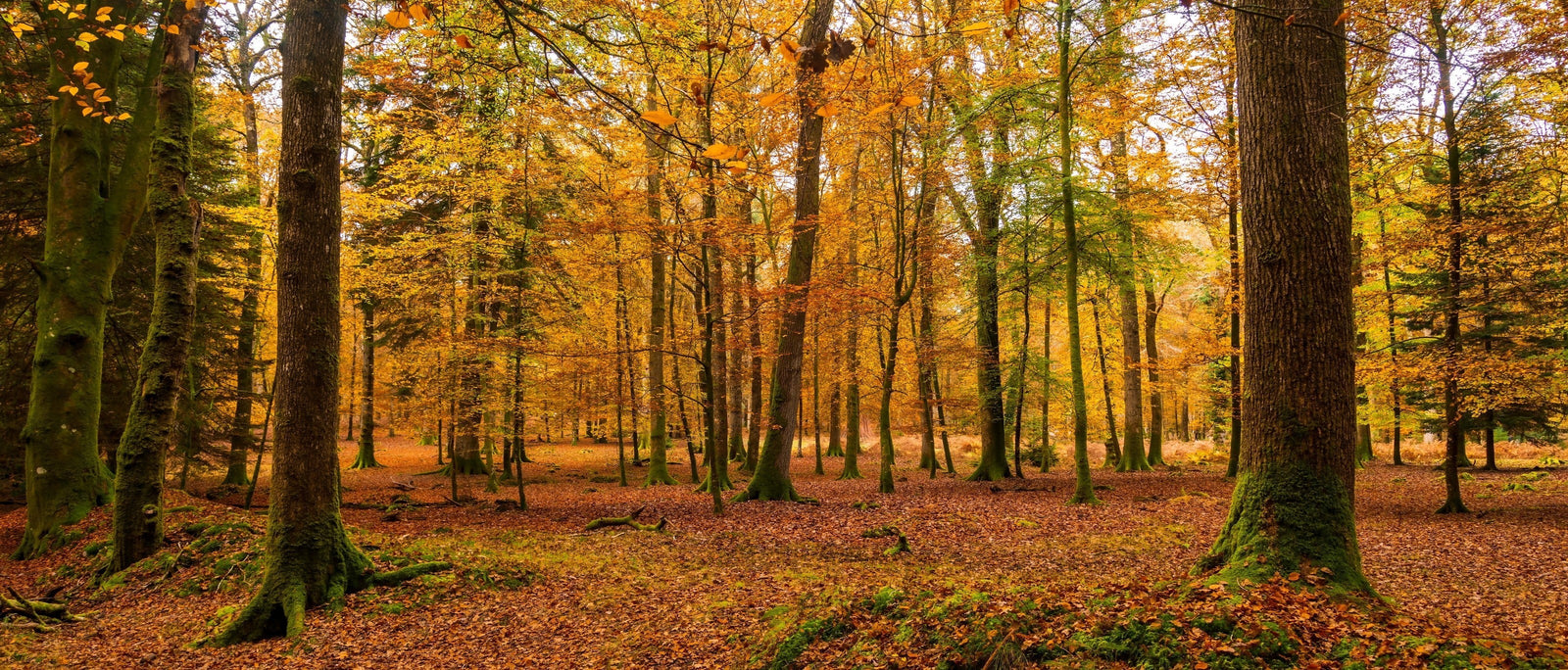
    Tall trees with golden-yellow autumn foliage rising from a carpet of copper leaves in the New Forest, their trunks green with moss. Image by allouphoto via Adobe Stock.
    Forest Gold: Britain’s Best Places to See Autumn Leaves

    Eight forests, gardens and arboretums where Britain’s woods put on their finest show – plus the science behind the colour, and a few tips for making the most of your walk.

    Silhouette of a red deer stag at sunrise, head raised and antlers swept back, with a plume of breath glowing in the golden light. Photo by DreamsCanBe via Adobe Stock
    The Deer Rut: Where to Watch Britain’s Wildest Autumn Spectacle

    Every autumn, Britain’s stags settle their differences the loud way. Here’s where to find the best of the action, from wild moorland to country estates, and how to watch it safely.

    Uffington White Horse. Prehistoric Bronze Age chalk hill figure Oxfordshire, England. Close up over head, eye, ears and neck. By David Matthew Lyons via Adobe Stock.
    Walking into Other Worlds | Britain’s Real Fantasy Locations

    From a chalk horse cut into Oxfordshire hillside to a Pembrokeshire beach scattered with painted pebbles, Britain is full of places where real and imagined worlds collide. Here are six locations that inspired some of fiction’s greatest fantasy writers.