
SAME DAY SHIPPING | FREE UK RETURNS | EU & INT'L SHIPPING

SAME DAY SHIPPING | FREE RETURNS

Tent Pegs & Stakes: The Ultimate Guide to Types & Uses
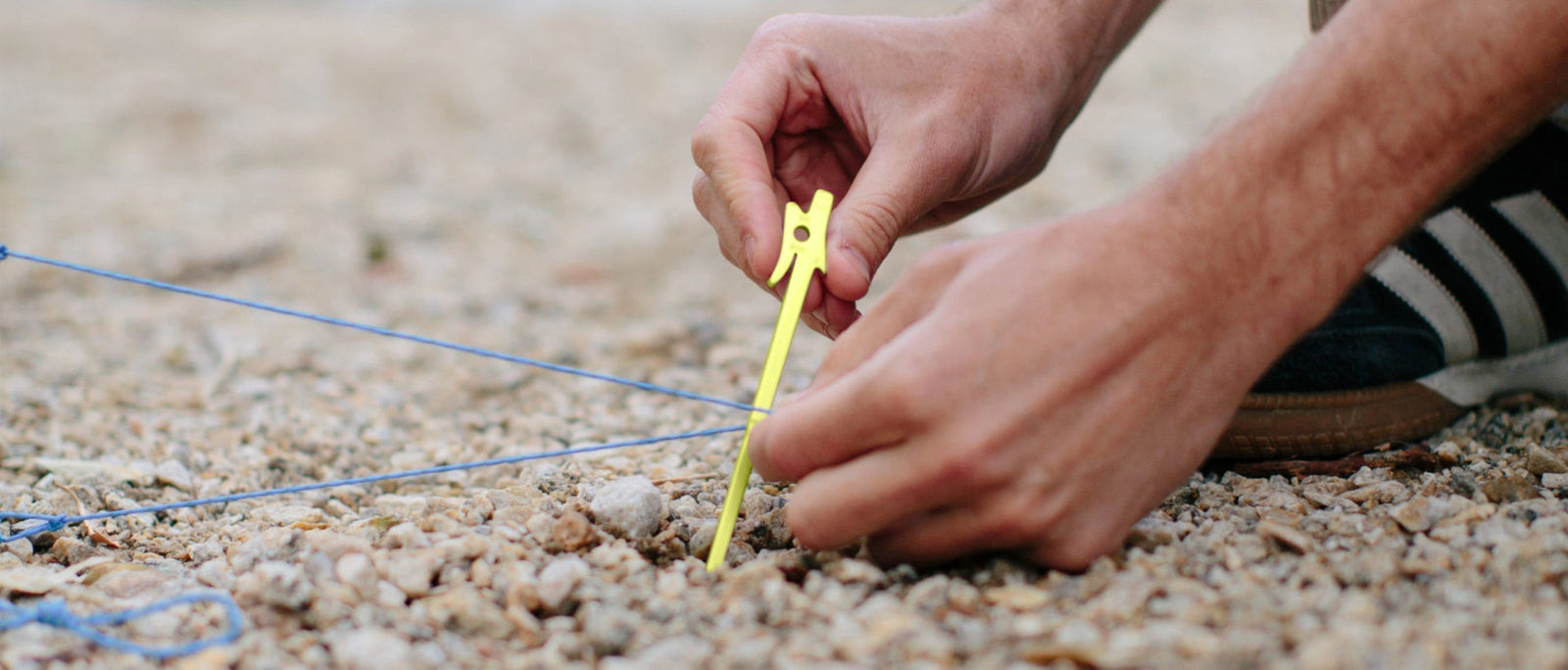
Which tent pegs are best for backpacking and wild camping? We highlight top designs for varying ground types to ensure a secure pitch every time.

Updated 29th July 2026 | Words by Matt Jones @ WildBounds HQ


Of all the different bits of kit out there for backpacking and wild camping, the humble tent peg is one of the most important. However, we reckon they’re also one of the most frequently overlooked.

After all, tent pegs (or stakes, as they’re usually known in the US) are a vital element of most shelter systems. For one thing, apart from your own body weight, they’re the only thing anchoring your tent to the ground. Along with the tent frame, they also create tension, stopping your shelter from flapping incessantly or, worse, collapsing around you. Either of those calamities will ruin a night in the great outdoors, especially in wet and windy weather. And it’s also worth remembering that no matter how stormproof your shelter, if the pegs securing it to the ground are weak and flimsy, you’re running the risk of a restless and discomfiting night.

Can I just use the pegs that come with my tent?

When you buy a tent, it is generally already supplied with a set of pegs or stakes. This is one reason why pegs tend to be treated as an afterthought when it comes to camping gear. The problem is that tent makers rarely seem to provide enough pegs to fully stake out your tent, especially if it has multiple guy-out points (sometimes they won’t supply all the guy lines either). From a manufacturer’s perspective, this saves weight and cost. But it’s pretty frustrating for first-time users. So, it’s worth checking you have all the pegs you need before you head out.

Then there’s the fact that the pegs which come with budget or lower-end tents aren’t generally the best quality – again, a cheeky cost-cutting exercise. Premium tents do tend to come with decent hardware, but even then, they might not be best suited to your needs or style of camping. After all, the manufacturer has no idea where you’ll be pitching up, what sort of ground you’ll be pitching on or how windy it might get.

What’s the best tent peg?

Unfortunately, there is no one ‘best tent peg’. Rain, wind and different soils all pose different challenges when it comes to holding power. This means that a particular design will work better than others, depending on the conditions. So, upgrading or expanding the pegs in your kit stash can give you a range of different designs to suit specific types of ground, as well as providing you with plenty of spares. This is useful in itself, since pegs – even decent ones – are easily lost, bent or broken.

In short, it’s essential to understand which stakes to choose, when, and why. Experienced backpackers and wild campers often end up owning several different types, which they select according to the conditions they expect to encounter. You may even want to carry a few different types of tent peg with you on your next adventure. This will allow you to pitch up almost anywhere and be confident that your tent will hold.

Which Tent Peg for Which Ground?

No single peg suits every surface. Use this quick-reference table to find the right type for the ground conditions you’re likely to encounter.

Peg Type Firm Soft Rocky Sandy Snow
Shepherd’s hook / wire
Nails and pins
Needle stakes
V-stakes
Y-beams
X-stakes / cross-beams
I-beams
Tube stakes
Delta Ground Anchors
Blizzard stakes / sand bags

Browse our full range of tent accessories, including all the peg types covered in this guide, or explore our wider camping tents and camping kit collections.

Tent peg designs

Tent pegs come in a myriad of different shapes, sizes and materials, with almost innumerable design tweaks and modifications from brand to brand. But there are a few basic types:

Kelty Nobendium stakes are an upgraded version of the classic shepherd's hook tent peg, made from high strength 7001-grade aluminium alloy with a hexagonal cross-sectional profile to resist spinning and deformation.

Shepherd’s hooks or wire pegs

Best for

Firm ground.

Pros

Inexpensive, widely available, easy to extract.

Cons

Bend easily, can spin in the ground.

This is the classic tent peg design, consisting of a straight shaft topped with a hook. Most have a circular cross-section, being made from bent metal wire – usually steel or aluminium, though some ultralight versions are made from titanium wire. These are exceptionally light (as little as 5g each) but need to be treated with care.

In general, shepherd’s hooks are best for firm or hard ground, as the straight shafts have a relatively small surface area, which means they don’t hold well in loose soil. They can sometimes spin in the ground too, allowing guy lines to slip off. Inserting the stake deep enough to embed the end of the hook in the turf helps prevent spinning.

Shepherd’s hooks remain popular because they are cheap and widely available. For backpacking or wild camping, it’s worth looking for high-quality 7000-series aluminium alloy versions, which don’t bend as easily as cheaper grades.

Recommended products

Kelty Nobendium Stakes – high-strength 7001-grade aluminium, hexagonal profile to resist spinning and bending.

Nordisk's titanium nail pegs can be hammered into extremely hard ground yet weigh just 8g each, which makes them a popular choice for lightweight backpackers who expect to be pitching on rocky terrain.

Nails and pins

Best for

Very hard ground and rocky or stony soil.

Pros

Lightweight, durable, robust – can be hammered into the hardest ground.

Cons

Guy lines can slip; poor performance in soft or loose ground.

A lighter, backpacker-friendly version of the heavy-duty steel ‘rock pegs’ often used to anchor big family tents and awnings, nails and pins are suitable for extremely hard and rocky ground. They’re usually made from titanium to minimise weight – the lightest versions on the market weigh as little as 8g each.

The minimalist design is simple but effective, typically consisting of a straight shaft with a sharp point at one end and a broader, flattened head at the other. They’re normally threaded with cord loops to make it easier to pull the peg back out. Despite being fairly thin they are very strong and highly resistant to bending, which means they can even be hammered into the ground. If you’re camping up high in rocky, mountainous terrain, they’re very useful.

Care must be taken to angle them sufficiently so that the guy line doesn’t slip off, which can happen if the line becomes slack. Looping the guyline twice around the shaft can help.

Recommended products

Browse titanium nail pegs in our tent accessories collection.

NEMO Airpin stake are needle stakes with a square profile and tapered geometry, made from premium 7075-grade aluminium with a knotless three-point locking guyline system.

Needle stakes

Best for

Hard ground and rocky or stony soil.

Pros

Lightweight and durable; thin diameter finds a way between buried stones.

Cons

Difficult to extract; poor performance in soft or loose ground.

These types of stakes are usually made from square-profile aluminium or titanium. They tend to be relatively short, since they’re designed for hard ground, when it’s difficult to drive in longer pegs. They also work well in stony ground, as their thin diameter can work its way between buried stones. As long as the soil is firm enough, they rarely work loose and don’t bend easily.

However, they can be tricky to extract, because most designs have only a small lip or hook at the top. If you’re struggling, use another peg or the loop of a guy line to pull them out. As with nails and pins, be careful that the guy line doesn’t slacken and slip off. Looping the guyline twice around the shaft can help.

Recommended products

NEMO Airpin Stakes – square-profile 7075 aluminium with a knotless three-point locking guyline system that prevents the line slipping off.

Sierra Designs V-stakes are good value tent pegs made from 7001 aluminium alloy, weighing less than 10g each, fitted with a loop toggle for easy removal.

V-stakes

Best for

All-round use, from soft to firm ground.

Pros

Lightweight, versatile, decent holding power in multiple soil types.

Cons

Can bend easily, especially at the head; not suitable for rocky or stony ground.

These pegs are popular with backpackers as they are light and compact yet very versatile, offering decent holding power in multiple different types of soils, ranging from soft to firm. The V-shaped profile is designed to increase their overall surface area without adding too much weight.

The original versions were made by DAC, an aluminium manufacturer, and designed by company founder Jake Lah (in fact, some people call them J-stakes after him). However, many brands make similar types.

The main disadvantage of V-stakes is that they bend easily if you try to push or hammer them into ground that is too rocky or stony. Failures are especially common at the head, which is the weakest point.

Recommended products

Kelty Feather Stakes – lightweight V-profile with integrated pull loop. Sierra Designs V-stakes – good-value high-grade aluminium with pull loop, sold in packs of six.

Sea to Summit Ground Control pegs have a Y-beam cross-section with triple guy line notches for versatile placement even when you can't get the peg all the way into the ground.

Y-beams

Best for

All-round use, from soft to firm ground – the best default choice for most UK conditions.

Pros

Versatile, robust, excellent surface area-to-weight ratio; works in most UK upland conditions.

Cons

Difficult to get into rocky or stony soil; harder to extract than simpler designs; aluminium versions will bend if repeatedly hammered.

As their name suggests, Y stakes or Y-beams have a Y-shaped cross-section, offering even greater surface area (and therefore holding power) than V-stakes with only minimal extra weight. This makes them great all-rounders, and they’re probably now the most popular type of tent peg for backpacking and wild camping. You can get by with these in most parts of the UK.

They work well in both soft and firm ground and are pretty robust – though aluminium Y-beams will bend or break if repeatedly hammered in with rocks. As with V-stakes, the head tends to be the weakest point. They can be difficult to get into rocky soil though, as they are often too thick to find their way between buried stones.

Y-beams come in multiple different lengths, and the basic design is offered by most of the big tent brands, though they’re not quite identical. For example, the highly regarded MSR Groundhog (and the shorter, lighter Mini Groundhog) have slightly curved and tapered flanges to improve overall holding power. They are thicker, stiffer, and stronger than cheaper alternatives too.

Sea to Summit’s Ground Control stakes are another good example of the Y-beam design. These have three handy notches for guy lines, which are useful to reduce leverage in firm soils where you can’t push them all the way in. They’re only notched on one of the three flanges though, so make sure you orient them correctly before driving them into the soil.

The Sierra Designs FL-stake is a simpler version of the same basic design. They’re good value but are made from high-grade 7001-series aluminium alloy and have integrated pull loops.

Recommended products

Sea to Summit Ground Control stakes – Y-beam design with three guyline notches, sold in packs of eight. Sierra Designs FL-stakes – solid value 7001 aluminium Y-beams with integrated pull loops.

The Swiss Piranha RT90 is an ultralight ABS plastic tent peg with a X-shaped profile. It is 9cm long and weighs just 3.1 grams. The large, round head allows it to be sunk flat, with slots for guy lines.

X-stakes or cross-beams

Best for

Firm ground.

Pros

Ultralight; high surface area allows shorter, lighter pegs without sacrificing holding power.

Cons

Durability concerns; the chunky X-profile can disturb more soil on insertion, reducing hold in soft, sandy or loose ground.

An evolution of the Y-beam design, these pegs have an extra flange to create an X or cross shape in profile. They have similar characteristics to Y-beam stakes with an even greater surface area. In turn, this means they can be made shorter and lighter while delivering equivalent holding power. However, one drawback is that the chunky X-shape seems to disturb more soil on insertion than less complex shapes, which potentially reduces holding power, especially in soft, sandy, and loose substrates.

This is perhaps why the design hasn’t yet caught on among many of the big outdoor brands, although Vaude makes an aluminium version (15cm long, 10g each), while Swiss Piranha makes innovative plastic versions in varying lengths, weights, and diameters. They’re very lightweight and a lot stronger than they look, but we wouldn’t rely on them in all conditions/locations.

Recommended products

Browse X-stake options in our tent accessories collection.

The Big Agnes Dirt Dagger is an I-beam stake made from 7A04 anodised aluminium alloy. The standard length is six inches and each peg weighs just 9g.

I-beams

Best for

All-round use across mixed terrain, from hard rock to soft mud.

Pros

Very strong and highly resistant to bending; wide surface area for excellent holding power; lightweight at just 9g each.

Cons

Relatively new design with limited availability compared to V- and Y-beams.

US backpacking brand Big Agnes has built a stellar reputation in recent years for its forward-thinking, innovative approach to lightweight outdoor gear. Its patent-pending I-beam Dirt Daggers are no exception, offering a unique take on tent stakes. The aim, just like the V-, Y-, and X-beam designs that came before them, is to maximise each peg’s overall strength-to-weight ratio.

The I-beam profile is inspired by the cross-section of a steel girder. As that suggests, they’re very strong and extremely resistant to bending, while providing a large, wide surface area for excellent holding power in mixed terrain, from hard rock to soft mud. The end is tapered to sink more easily into the ground. It’s an intriguing concept – particularly since the 6" versions only weigh 9g each. There are also longer 10" versions for even better holding power. 

Recommended products

Big Agnes Dirt Dagger UL Stakes – patent-pending I-beam profile in 7A04 anodised aluminium, 10-inch (25cm) length, sold in packs of six.

Popular with US backpackers, Easton Nano stakes are crafted from aviation-grade 7075 aluminium alloy, with a drilled head for optional cord attachment. They weigh 8g per peg.

Tube stakes or ‘Easton stakes’

Best for

All-round use in soft to firm ground.

Pros

Very resistant to bending due to thick cross-section; similar holding power to V-stakes of comparable length.

Cons

Expensive; carbon-fibre versions are brittle and should not be hammered into hard ground; less common in the UK.

Tube stakes are made of either hollow aluminium, carbon fibre, or composite material with a flattened head cap and a pointed tip. They’re not so common in the UK but are popular with thru-hikers in the US, where they were first developed by the brand Easton (hence their alternative name).

As they have quite a thick cross-section, they are very resistant to bending, though better suited to soft or firm rather than hard ground. Carbon-fibre versions are extremely stiff and strong but also brittle (as well as expensive), so don’t try to hammer them into hard ground! Still, aluminium tube stakes can handle tougher soils than most shepherd’s hooks. They also offer similar holding power to V-stakes of comparable length.

Since they lack a hook at the top, tube stakes should be angled sufficiently so that the guy line doesn’t slip off, which can happen if the line becomes slack. Looping the guyline twice around the shaft can help.

Recommended products

Browse tube stakes in our tent accessories collection.

Delta ground anchors are an unusual but highly effective nylon tent peg that are designed, developed and manufactured in the UK.

Delta Ground Anchors

Best for

Soft, shallow turf over hard bedrock – exactly the sort of ground common in UK uplands.

Pros

Holds well in shallow soil where longer pegs hit rock; offset design minimises risk of levering out; designed and made in Britain.

Cons

Comparatively heavy (49g each) and bulky; not suitable as a general-purpose peg.

Designed in Britain, the patented Delta Ground Anchor is another unique type of peg that merits mention. The unusual offset shape increases overall surface area for resistance yet also adds a remote point of attachment to minimise the risk of the peg levering out of the soil. The basic principle is similar to that of a deadman anchor as used in climbing.

The lightest versions are made from engineered thermoplastic, though they still weigh a comparatively hefty 49g each. However, they’re particularly effective in soft, shallow turf over hard bedrock – exactly the sort of ground you often find in UK uplands. This stuff is often problematic, as pegs long enough to hold well in the spongy turf typically hit solid rock before you can get them all the way in. This makes secure placement tricky, especially when wild camping or backpacking along Britain’s more remote and challenging long-distance trails.

It’s perhaps no surprise that Delta pegs have thus become popular with many UK backpackers, though due to their weight and bulk, they tend to carry no more than three or four, for use at critical pegging points.

Recommended products

Delta Ground Anchors – patented UK-designed thermoplastic anchors; best used at critical guy points where other pegs fail in shallow upland turf.

Blizzard stakes and sand bags are designed for specialist applications such as when pitching in very loose ground, such as sand and snow.

Blizzard Stakes and Sand Bags

Best for

Very loose soil, sand, and snow.

Pros

Works when other stakes would fail; can be buried as a deadman anchor in extreme conditions; durable.

Cons

Heavy, bulky, and only useful in specific scenarios – not a general-purpose peg.

Very much a specialist type of tent peg, these stakes are designed for use in snow, sand, and other very loose substrates. They have a long, wide shape with a large concave surface area; most also have punched holes to reduce weight and enable attachment of guy lines below the surface to further increase overall holding power. In extreme cases, it’s even possible to completely bury these stakes, just like a deadman anchor. You won’t generally need them unless you do a lot of winter camping in deep snow (e.g. somewhere like the Cairngorms) or perhaps if you’re planning to beach camp on a multi-day coastal walk or sea kayaking trip.

An alternative to traditional sand/snow stakes are ballast bags, which secure and stabilise your tent. These zippered triangular bags are made from high-denier polyester and can be filled with up to 20lbs (9kg) of weight in the form of ballast such as sand, rocks, or snow. They work particularly well for beach camping or when you need to pitch on hard-standing or a wooden tent platform.

Recommended products

Kelty Sand Bag Stakes – high-denier polyester bags that can be filled with up to 9kg of sand, rocks or snow; ideal for beach camping and hard-standing pitches.

It's important to insert tent pegs correctly to maximise their holding power.

Top Tips for Placing Tent Pegs and Stakes

It’s important to insert tent pegs correctly to maximise their holding power.

  1. When pegging out your footprint, tent inner, or flysheet, position each peg diagonally away from corners or in line with the seams of the fabric.
  2. When pegging out guy lines, make your lines as long as you can. The flatter the angle of the guy line to the ground, the more force is being transferred to soil-to-soil friction (which is what keeps the peg in the ground).
  3. If you’re struggling to push the peg into hard ground, try using the heel of your boot or find a flattish rock to gently tap them in. Be careful not to bend or break them though.
  4. General advice is to angle pegs about 45 degrees away from the direction of pull – though in our experience, different types tend to work better at different angles.
  5. Tent pegs that lack a guy line notch or hook (e.g. nails, pins, and tube stakes) all need to be angled sufficiently to prevent the guy line from slipping off, which can happen if the line slackens over time (as can happen in gusty conditions).

What are the best tent pegs for hard ground?

For very hard or rocky ground, nails and pins are the go-to choice – they’re thin enough to drive between buried stones yet strong enough to be hammered in without bending. Needle stakes in square-profile aluminium or titanium are a good alternative, with a similar profile that works well in stony ground. If the ground is hard but not rocky – firm chalk downland or compressed clay, for example – a good Y-beam such as the MSR Groundhog or Sea to Summit Ground Control will also perform well. Avoid V-stakes and X-stakes on hard, stony ground, as both can bend at the head.

What tent pegs are best for soft or sandy ground?

For soft, sandy, or very loose substrates, you need maximum surface area to prevent the peg pulling straight out. Blizzard stakes (wide, flat pegs with a large concave face) are the specialist choice for snow and sand, and can be buried entirely as a deadman anchor if conditions demand it. Kelty Sand Bags are a practical alternative for beach camping – fill them with sand or stones and use them as ballast anchors. For soft but not loose turf (boggy upland ground, for example), V-stakes, Y-beams or I-beams will generally hold well. Avoid shepherd’s hooks and needle stakes in any kind of loose or soft ground.

How many tent pegs do I need?

As a minimum, you need enough pegs to fully stake out your tent’s footprint and vestibules. Ideally, you also want enough spares to stake out all its guy lines too. The exact number depends on the tent design – check the manufacturer’s specification and count the attachment points. Most three-season backpacking tents need somewhere between eight and twelve pegs when fully guyed out. The problem is that tent manufacturers often supply fewer pegs than this, and the ones they do supply are sometimes poor quality. It’s worth buying a small stash of extras (four to six spares) so that you’re covered if a peg is lost, bent or broken mid-trip. For exposed or wild camping in challenging conditions, erring on the side of more pegs rather than fewer is always sensible.

What angle should tent pegs go in at?

The standard guidance is to angle tent pegs at around 45 degrees away from the direction of pull. In theory this maximises the mechanical advantage of the peg against the force being applied. In practice, different peg types perform best at slightly different angles: Y-beams and V-stakes generally follow the 45-degree rule well, while nails, pins and tube stakes may need to be angled a little more steeply to keep the guy line from slipping off the top. In other situations, we’ve found that driving a peg in vertically gives the best holding power. The flatter (shallower) the angle of the guy line to the ground, the better the holding power in general, so always run lines as low and long as possible.

Do all tents come with pegs?

Yes – if you buy a new tent it should include a set of pegs, but the quantity and quality varies considerably. Budget and mid-range tents often come with a limited number of basic shepherd’s hook or wire pegs that aren’t well-suited to challenging conditions. Premium tents tend to come with better hardware – often Y-beams or similar – but may still not supply enough pegs to fully guy out the tent, particularly if it has multiple guy-out points. It’s always worth checking how many attachment points your tent has and comparing that to the number of pegs supplied, then buying extras as needed. Upgrading even a few key pegs to a better (or different) design can make a meaningful difference to how securely your tent holds in windy and wet conditions.